Is Your Phone Listening to You? The Truth About Targeted Ads
We’ve all been there. You’re at Sunday brunch with a friend, waiting for your eggs benedict. You spend ten minutes venting about how your lower back is killing you and how you really, really need a new ergonomic office chair. You haven’t searched for chairs. You haven’t emailed about chairs. You merely spoke about them.
Two hours later, you open Instagram, and there it is. A sponsored post for the “CloudComfort 3000” lumbar support chair.
A cold shiver runs down your spine. You look at your smartphone sitting innocently on the table. It feels less like a tool and more like a wiretapped informant. You ask yourself the question that haunts modern society: is my phone listening to me?
It’s the ultimate 21st-century ghost story. Is it coincidence, or is it spycraft? As a tech journalist who has spent years digging into the messy guts of data privacy, I’m here to tell you the answer is both more reassuring and more disturbing than you think.
The Logistics: Why It’s Probably Not Audio
Let’s start with the boring but necessary reality check: physics and economics.
If Facebook, Google, or Amazon were actually recording every conversation you had 24/7 to scan for keywords like “ergonomic chair” or “sushi burrito,” the logistics would be a nightmare.
First, think about your battery. Processing real-time audio requires your processor to be awake and crunching data constantly. If your phone were secretly recording everything, your battery wouldn’t last until lunch. It would run hot in your pocket, burning through power to keep that microphone feed alive.
Second, consider the data. High-quality audio files are heavy. Uploading hours of conversation from billions of users to the cloud every day would result in an astronomical amount of data usage. You’d notice your data cap vanishing instantly, and the tech giants would be spending trillions (with a T) on data storage centers just to hold onto recordings of you singing in the shower.
Security researchers have decompiled the code of popular apps like Facebook and Instagram time and time again. While they find plenty of trackers, they haven’t found the “secretly stream audio” code. It’s just too expensive and clumsy to be the primary method of spying.
The Real Culprit: Your Digital Profile
If they aren’t listening, how did they know about the chair?
Here is the twist: They don’t need to listen to you to know what you want. They know because you have already told them, just without speaking.
Think of your online identity as a massive Digital Puzzle. Every time you hover over an ad, like a post, share a meme, or even pause your scrolling for two seconds on a video, you hand the algorithm a puzzle piece.
Social media targeted ads are built on these thousands of tiny data points.
- Demographics: They know you are 30-40 years old and work a desk job.
- History: They know you bought a new desk last month (credit card data partnerships).
- Behavior: They know people with your profile usually start having back pain right about… now.
The algorithm isn’t a spy in the corner with a notepad; it’s a master detective deducing your next move based on the trail of breadcrumbs you’ve left behind for years. It predicted you wanted that chair because statistically, you were due for one.
The “Location” Loophole: The Friend Proximity Theory
“But wait!” you say. “I never searched for a chair. I only talked about it with Dave at brunch!”
This is where things get truly wild. This is often called the “Friend Proximity” theory.
Your phone knows where you are via GPS, Wi-Fi triangulation, and Bluetooth beacons. It also knows that Dave’s phone was in the exact same location for two hours. The algorithms determine that you and Dave are friends (or at least close associates).
Here is the kicker: Maybe Dave searched for office chairs.
If Dave has been looking at lumbar support reviews all week, and then he hangs out with you for two hours, the algorithm assumes you share interests. It thinks, “Dave likes chairs. Dave likes you. You probably like chairs.”
Suddenly, you get an ad for something you discussed but never searched for, simply because the person you were talking to did search for it. You aren’t being listened to; you are being effectively “infected” by your friend’s search history.
The Exception: Voice Assistants
Now, let’s address the elephant in the room, or rather, the cylinder on the counter. What about Alexa, Siri, and Google Assistant?
This is where voice data collection gets tricky. These devices are technically “always on” in the sense that they are waiting for a specific “Wake Word” (like “Hey Siri” or “Okay Google”). In theory, and according to these companies, nothing is sent to the cloud until that magic phrase triggers the system.
However, accidents happen. We’ve all seen our smart speakers light up when nobody said their name. In those instances, short snippets of audio can be recorded and sent to servers for analysis to improve voice recognition. While tech companies claim this data is anonymized, it is the one area where the “listening” fear has some grounding in reality. But generally, this data is used to train AI to understand accents, not to sell you shoes.
The Psychological Factor: The Frequency Illusion
There is one final piece to this puzzle that exists entirely inside your head. It’s called the Baader-Meinhof phenomenon, or the Frequency Illusion.
We are bombarded by thousands of ads a day. Most of them are irrelevant garbage that our brains filter out immediately. You probably scrolled past three ads for car insurance and one for dog food this morning without registering them.
But the moment you talk about “office chairs,” your brain primes itself to look for “office chairs.” When the algorithm throws a random chair ad at you (which it might have done yesterday, too, but you ignored it), you spot it instantly. You notice the hit and ignore the thousand misses. It feels like magic, but it’s mostly just selective attention.
Take Control: How to Protect Your Privacy
Even if they aren’t recording your conversations, the amount of data being collected is still unnerving. If you want to tighten up your digital ship, here are the steps to take right now:
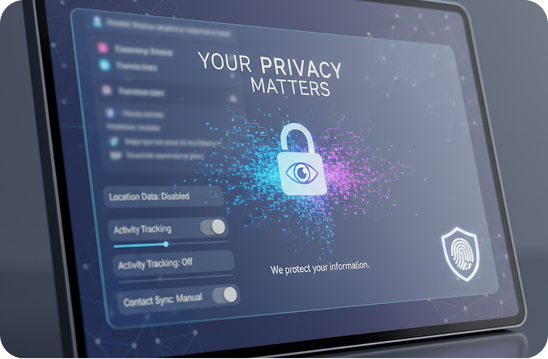
- Audit Microphone Permissions: Go to your phone’s settings (Privacy > Microphone). Look at which apps have access. Does your flashlight app need to hear you? Does that random solitaire game need your mic? Turn them off.
- Disable “Personalized Ads”: In your Google and Facebook settings, you can turn off ad personalization. You will still see ads, but they won’t be based on your eerie behavioral profile.
- Limit Location Tracking: Set location access to “While Using App” rather than “Always” for apps that don’t need 24/7 GPS data.
- Check Voice Assistant History: You can actually log into your Amazon or Google account and listen to the voice recordings they have stored, and delete them.
Conclusion
So, to answer the burning question: Is my phone listening to me?
Almost certainly not in the way you fear. There is no guy in a van with headphones, and there is no secret tape recorder running 24/7. The reality is actually more humbling.
Tech giants don’t need to listen to your private conversations to know what you want. They have built a mathematical model of your life so accurate that they can predict your desires before you even voice them.
They aren’t eavesdropping; they are just really, really good at guessing. And frankly, that might be scarier than a microphone ever could be. It turns out we humans aren’t as unpredictable as we like to think.