We all know the dance. You’re standing at the checkout counter, bags packed, line forming behind you. You reach into your back pocket or purse, and your heart drops into your stomach.
It’s not there.
The panic of losing a physical wallet is primal. In a split second, you visualize the nightmare ahead: canceling five different cards, losing that $20 bill you swore you had, filing a police report, and the distinct misery of standing in line at the DMV to replace your driver’s license.
Now, imagine you lost your smartphone instead. It’s annoying, sure. It’s expensive to replace. But is your financial life in ruin? Surprisingly, no.
We tend to cling to our leather bifolds and plastic cards because they feel “real” and tangible. We trust what we can hold. Conversely, many of us look at our smartphones with suspicion, viewing them as fragile portals to the dark web. But here is the irony: digital wallet security has quietly surpassed physical wallet security by a massive margin.
If you are one of the holdouts still inserting a chip or (heaven forbid) swiping a magnetic strip because you are worried about hackers, this guide is for you. It’s time to rethink what it means to keep your money safe.
The “Stunt Double” Strategy: How Tokenization Protects You
To understand why Apple Pay security and Google Pay security are superior to plastic, you have to understand how a standard credit card works.
When you hand a waiter your physical VISA card, you are handing them the keys to the castle. That 16-digit number, the expiration date, and the CVV code on the back are all they need to go on a shopping spree on Amazon. You are trusting that the waiter, the card reader, and the merchant’s database are all honest and secure.
Digital wallets use a piece of tech magic called “Tokenization.” Think of this like a Hollywood movie set.
Your actual credit card number is the A-List Celebrity (let’s say, Tom Cruise). The studio (the bank) never wants Tom Cruise to be in actual danger. So, when it’s time for a dangerous scene (like a transaction at a sketch gas station) the studio sends in a Stunt Double.
In technical terms, this Stunt Double is a “Device Account Number” or a unique transaction code. When you tap your phone to pay, your phone sends the Stunt Double to the card reader. The merchant never meets Tom Cruise (your real card number). They only meet the Stunt Double.
Why is this a game-changer? If that merchant gets hacked -think of the massive data breaches at Target or Home Depot in the past- the hackers steal a database full of Stunt Doubles. These tokens are useless without the specific phone used to generate them. They cannot be used to make a copy of your credit card.
Biometrics vs. The Scribble: Why Your Face is the Best Password
Let’s play a game of “What If.”
- Scenario A: You drop your physical credit card on the sidewalk. A stranger picks it up. They walk into a grocery store, buy $200 worth of steaks and wine, and tap the card. If the machine asks for a signature, they scribble a vague wavy line. The cashier nods. The transaction is approved.
- Scenario B: You drop your iPhone or Android on the sidewalk. A stranger picks it up. They walk into a grocery store and try to use Apple Pay or Google Pay.
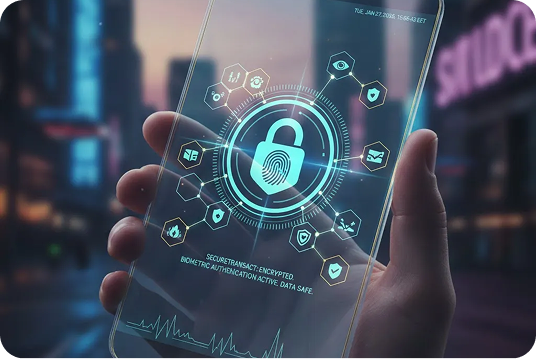
They hold the phone to the terminal. Nothing happens. The phone demands a face (FaceID), a fingerprint (TouchID), or a complex passcode. Without your biology or your secret code, that phone is a brick. It cannot pay for anything.
This is the core difference in contactless payment security. Physical cards rely on security measures from the 1980s: a signature that nobody checks and a magnetic strip that is easily cloned.
When people ask, “Is Apple Pay safe?” or “Is Google Pay safe?” They are often worried about high-tech hackers intercepting radio waves. But the reality is much simpler: Theft happens when physical objects are stolen. A digital wallet requires authentication for every single purchase. A physical wallet does not.
If you lose your plastic card, your money is vulnerable instantly. If you lose your phone, your money remains locked behind biometric security.
The Skimmer Defense: defeating the Gas Station Thief
If you live in the modern world, you have probably heard of “skimmers.” These are nasty little devices that thieves attach over the legitimate card readers at gas pumps and ATMs. They look identical to the real slot.
When you slide your physical card into a skimmer, it reads the magnetic stripe, the black strip on the back of your card. That strip contains static data: your name, number, and expiration date. Once the skimmer has that, the thief can clone your card onto a blank piece of plastic and drain your account.
This is one of the most common mobile payment security risks, but only if you aren’t using a mobile wallet!
Digital wallets are immune to skimmers. Because Apple Pay and Google Pay use NFC (Near Field Communication) and the tokenization process we discussed earlier, there is no magnetic strip to read. Even if you hold your phone near a skimmer, the thief gets nothing. The “Stunt Double” token is a one-time-use code or device-specific code. It cannot be skimmed, cloned, or reused.
By relying on contactless payment security, you are effectively making yourself invisible to one of the most common forms of street-level fraud.
The Risks (Let’s Be Real for a Second)
Is any system 100% perfect? No. It would be irresponsible to say there are zero mobile payment security risks, but they look very different from the risks of physical cash.
The biggest risk to your digital wallet is… you.
If your phone’s passcode is “1234” or “0000,” you have essentially left the keys in the door. If someone steals your unlocked phone, or knows your simple passcode, they can potentially use your wallet.
However, even in the worst-case scenario where your phone is stolen, digital wallets have a “Nuclear Option” that leather wallets lack: Remote Wipe.
- Find My iPhone (Apple) and Find My Device (Google) allow you to log into a computer, locate your phone on a map, and instantly “nuke” it. You can lock the device or erase all data (including your credit cards) remotely.
- Try doing that with a lost leather wallet. You can’t “remote wipe” a $50 bill or a driver’s license.
Ditch the Leather, Trust the Silicon
We are creatures of habit. We like the tactile “snap” of a credit card against the counter. But the data is clear: the magnetic stripe is a relic of the past, and it is leaving you vulnerable.
So, to answer the burning questions:
- Is Apple Pay safe? Yes. It shields your real data and requires your face or fingerprint to work.
- Is Google Pay safe? Absolutely. It utilizes the same tokenization standards that banks prefer over plastic cards.
Digital wallet security isn’t just a buzzword; it is a robust fortress built on encryption, biometrics, and tokenization. Your physical wallet is just a piece of leather.
Final Advice: You don’t have to burn your physical wallet just yet. Keep a physical card on you as a backup (batteries do die, after all). But for your daily coffee, your grocery run, and your gas tank fill-up? Keep the plastic in your pocket and use the phone. It’s faster, it’s easier, and it’s a whole lot safer.